Wednesday, April 15, 2015

Port Wings Editorial: Modi needs a better economic advisor

Source: http://www.portwings.in/editorial/modi-needs-a-better-economic-advisor/
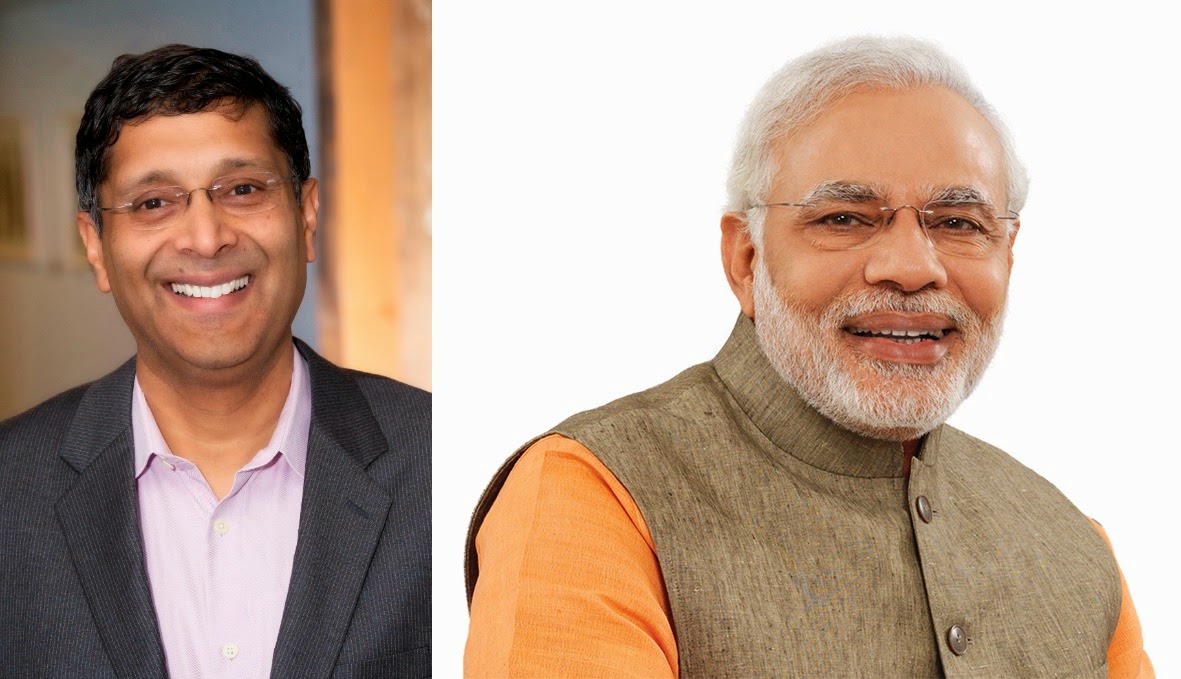
Editorial in Port Wings, April 15, 2015:


While the Prime Minister Narendra Modi exuding great confidence among the countrymen at every available forum, be it a corporate-sponsored meetings or through his Mann Ki Baat, that the mess created by previous governments in New Delhi will be cleared and indeed a new era will dawn soon, his chief economic advisor Arvind Subramanian, the US-based thinker roped in by Sudhesi-loving BJP Government, speaks exactly opposite to his views.
Recently, Subramanian was in Chennai and where he emphatically said that the big bang reforms are frankly not applicable to a country like India as there was multiple veto centres, multiple decision making centres and was very difficult to pass through a decisive change.
Though Narendra Modi, after being elected to lead the world’s largest democracy about a year ago, announced that his government will walk the talk on economic reforms and put the country on fast track, the open admission by his economic advisor clearly demonstrates that either both were not in ideological sync or fooling around the countrymen with double speak.
Ever since Narendra Modi appointed Arvind Subramanian to the post, there were murmurs in the corridors of power that the BJP-led government too following the same principles of Congress and totally relying on imported economists, someone who does not know the ground realities of the sprawling country.
And those murmurs are being proved right every time of late when Arvind Subramanian speaks about the economic status of the country in public forums.
It is an open secret that the previous Manmohan Singh-led Congress Government had multiple power centres and because of that the decisions on several important policies, including the economic reforms, were unable to culminate in the best interest of the country.
Well, Indians voted the Congress government out of power and brought the BJP Government after its PM Nominee Narendra Modi assured that there won’t be any such setup in the new government and it will prosper on the lines of Sabka Saath, Sabka Vikaas.
However, the promise of weeding out such unscrupulous setup seems to be lost in transition or kept in abeyance as his economic advisor still speaking about the existence of multiple veto centres in the country.
If one read between the lines, the latest outburst clearly demonstrates that nothing has changed than change of government in New Delhi.
The continuation of Arvind in the economic advisor post despite different views suggests that Narendra Modi like the way he was working.
The previous Manmohan Singh-led Congress Government had advisors, again imported from United States of America, and those experts decided the economic policies of India, which has diversified system and patterns.
Manmohan Singh’s advisors had even failed to gauge the living conditions of poor countrymen and emphatically boasted for the corporate sector and decided pro-corporate policies which ultimately led to the downfall of the Congress Government.
Traditionally, the chief economic adviser is responsible for feeding the Prime Minister about the prevailing economic conditions and suggests steps to be taken. 
The admission by advisor tells a different story that Narendra Modi is still unable to overthrow the legacy of Congress.

Monday, April 13, 2015

Tacit support from China, Japan helps flourish Redsanders smuggling: Experts

Source:http://www.portwings.in/general/tacit-support-from-china-japan-helps-flourish-redsanders-smuggling-experts/

Port Wings News Network:
The recent killing of 20 woodcutters from Tamil Nadu in the Seshachalam Hills, Andhra Pradesh, for allegedly smuggling redsanders has opened a fierce debate among the activists on the sophisticated shadow network of smuggling of the products banned under the Convention on International Trade in Endangered Species of wild fauna and flora (CITES).
Besides, the killings also raised serious doubts over the government of Andhra Pradesh’s ability on curbing the smugglers and also the moral responsibility of China and Japan, which is accepting the illegally traded goods giving scant regard to CITES obligation that put the onus on both the countries to curb smuggling.

What is Redsanders:

Red Sanders is an endangered species found naturally only in four districts of Andhra Pradesh. The tree growth is extremely slow and takes decades to gain thickness. The deep red-coloured wood is sturdy and does not lose shape even in harsh temperatures and humidity.
Though there is no final conclusion on the usage red Sanders, there is a common belief that it is used in making musical instruments, sculpture, furniture and medicines in China and Japan.
Besides, it is also alleged that redsanders is used as a temperature coolant in nuclear reactors in China.

What is CITES?

CITES (the Convention on International Trade in Endangered Species of Wild Fauna and Flora) is an international agreement between governments. Its aim is to ensure that international trade in specimens of wild animals and plants does not threaten their survival.
CITES is an international agreement to which countries adhere voluntarily. Counties that have agreed to be bound by the Convention are known as Parties. Although CITES is legally binding on the Parties – in other words they have to implement the Convention – it does not take the place of national laws. Rather it provides a framework to be respected by each Party, which has to adopt its own domestic legislation to ensure that CITES is implemented at the national level.
In the case of redsanders, it has been clearly established that both China and Japan are violating the CITES obligation thus favouring the illegal trade.

Patronage from China and Japan for Smuggling:

Redsanders is easy to carve and a tonne of the wood fetches between Rs 20 lakh and Rs 40 lakh in the international market, which is China and Japan.
According to Andhra Pradesh Forest Department estimates, 3,000 tonnes of redsanders are illegally removed from its forests every year and exported via sea as well as air through dubious exporters in China and Japan.
Red Sanders smuggling has been going on for a long time, but has increased substantially in the past few years.
Though around 1,000 tonnes of redsanders is seized every year in the country against the 3,000 tonnes of “Production,” no one in the governmental setup responsible for curbing the illegal trade, be it Customs Department, Department of Revenue Intelligence (DRI) or even the Central Bureau of Investigation, never reached the actual exporters or importers in China and Japan.

The Mode of Trade:
As per government estimates, more than two third of the illegally removed redsanders gets smuggled out of the country.
Speaking to Port Wings, one of the exporters of agri commodities to Far East on condition of anonymity, said, “Going by the official estimates, about 2000 tonnes of redsanders are being smuggled out of the country either through sea or air. So, it has been established that Customs Department has failed to curb the trade in the absence on robust checking measures. On the other hand, we never heard a single case of redsanders seizure from China or Japan till now and it clearly suggests that both the countries are hand-in-glove with the smugglers.”
“Hence, it is clear that both China and Japan are the main culprits in the illegal trade and due to their tacit support for redsanders, the smuggling of the wood is rampant from India,” he added.
According to information available, in the 1930s, Japan commenced to import Indian redsanders for the manufacture of the traditional Shamisen musical instrument and the market remains important even today at a level of several hundred tonnes per annum.
Demand by Japan for wavy grain quality timber resulted in significant illegal destructive exploitation of the wild resources in 1950s and 1960s.
Besides Japan, China as well as a number of other countries in the East are known to import redsanders, for various use.

Only Interpol rein in on China & Japan:

According to experts, INTERPOL should investigate the usage of illegally imported redsanders in China and Japan, and find those “Importers” to fix culpability in supporting the trade.


Wednesday, March 18, 2015

Sravan Shipping on expansion mode, plans 2 more CFSs in AP

Source:http://www.portwings.in/articlesinterviews/sravan-shipping-on-expansion-mode-plans-2-more-cfss-in-ap/
Port Wings News Network:

Mr. G.Sambasiva Rao, Managing Director, Sravan Shipping Services Pvt Ltd,

Given the consistent growth in port-related business in the region, we are planning to develop two more container freight stations (CFSs) in Andhra Pradesh in next two years, Mr. G.Sambasiva Rao, Managing Director, Sravan Shipping Services Pvt Ltd, has said.
In an exclusive interview to Port Wings, Mr Sambasiva Rao said, “The business potential will double after the completion of second CFS near Gangavaram Port in the near future, a reality by the end of 2015. Krishnapatnam CFS is the third making inroads by the first half of 2017.”
“I am very optimistic about achieving this goal. With additional CFSs and Logistics space coming up, we will provide the much needed back up support infrastructure,” he added.
Excerpts…
Sravan logo 1Q. Tell us about the Sravan Shipping Services?
G Sambasiva Rao: “As an entrepreneur, I have the satisfaction of having created an organization of 1200 people by setting up first Container Freight Station in private sector in Visakhapatnam, Andhra Pradesh in 2004 having 10 lakh Sq. ft. covered warehouse( including customs bonded) space & 25 lakh sq. ft open storage space with business verticals of stevedoring, Custom House Agency, Shipping agency, Clearing & Forwarding, cargo handling & warehousing and Transportation with end-end logistics services based on a robust foundation of innovation, people, values, and customer-centricity.”
Q. Will you share your entrepreneurship journey like how it began?
GSR: “An entrepreneur is a person who undertakes and operates a new venture, and assumes accountability for the inherent risks associated with it. An entrepreneur is one who made significant progress in translating his insight into reality. I saw the big picture for end-end-logistics with having world class CFS first in the private sector in AP and warehousing facilities with ISO 9001-2008 Quality standards in and around East coast of India. It helped me to ring-fence the ripples of contemporary developments.”
Q. Tell us about the growth of Brand Sravan over the years?
GSR: “Buoyed by the initial success, I aggressively built SRAVAN brand and even now keep our customers sharply in focus. It helped me to open the right doors for Sravan Shipping Services Pvt Ltd. My ability to discern the direction of change and steering the ship well in time is keeping the company ahead of competition. After putting SSSPL on a steady growth course, now I am focusing on charting out the “next horizon” for the company. In that role, I am working on not only seeing the future but also in preparing SSSPL to thrive in that future. Tirelessly, I am moving on the vision for the organization with basic parameters like how to achieve on time performance and reliability that is springboard to success.”
Q. Share your experience in building the Brand Sravan?
GSR:  “Looking back today, I believe my sincere efforts contributed as much to my success as anything else. The journey so far for me has been full of thrilling moments and disappointing times, as is the case with any entrepreneurial venture. Only unbridled passion would help you to pass through the rigor and pains that are part and parcel of any start-up process. I strongly believe business excellence is all about creativity. Growth can be seen from the way the business looks with new thoughts and new segments are lined up for expansion.”
Q. How do you see the new government and its initiatives?
GSR: “India is a huge country but if everybody works in their respective districts and focuses on the development of that district, we will have balanced and well distributed growth. There is no stopping India from becoming one of the major forces in the world by 2020. Yet more needs to be done. We have to cut down a lot on licenses and bring the Single Window Policy to realization. We need to train more skilled manpower (not only engineers, graduates and post-graduates).”
Q. In your view, which sector could foster entrepreneurship skills in youth?
GSR: “I firmly believe that educational institutions can help foster entrepreneurship, which is why I want to  involve with the Innovation & Entrepreneurship Programmes in educational institutions  — a business Incubator where ideas from students and alumni can be commercialized. I am excited by the potential and drive in today's generation of aspiring entrepreneurs and very optimistic about the future of entrepreneurship in India. Entrepreneurship is all about passion and a vision. You don’t require only money to build great businesses. You require looking beyond, seeing the future and just grabbing the opportunity and then having a lot of perseverance.”
Q. What is your message to the budding entrepreneurs?
GSR:  “This is a good time to be an entrepreneur in India. Today, we have successful role models, India is growing rapidly, economic liberalization is going on in full swing, and India enjoys a favorable positioning as a brand in the global markets. Government policy is increasingly becoming progressive and the business environment is more conducive, which is a very welcome development because India needs many more entrepreneurs across industries if it has to achieve and sustain the kind of growth we as a nation seek. There is no business in the world that is non-profitable but everybody has not been able to build profitable businesses. There are risks and so also rewards. Patience is important. Any business that makes money overnight will not have strong fundamentals.”

Port Wings Editorial: Welcome Move, but ensure proper spending on tracks

Source: http://www.portwings.in/editorial/welcome-move-but-ensure-proper-spending-on-tracks/

The decision by the Life Insurance Corporation of India to invest about 1.5 lakh crore in Indian Railways is a welcome move indeed.
Even though the LIC has been investing in public-sector firms for the past several years, the latest decision committing a whopping 1.5 lakh crores for the growth of Indian Railways, another public sector transport institution linking every nook and corner of the country and ferrying huge quantity of freight and lakhs of passengers every day, has once again proved that LIC is the most dependable automated teller machine for the government.
It is worth recalling here that LIC manages assets worth Rs 13 lakh crore which is equal to 15% of India's gross domestic product of Rs 85 lakh crore. Its investment in government-owned companies as on May 2012 was about Rs 1 lakh crore. This is the first time that LIC has unveiled its intention to invest such a huge amount for a single entity.
LIC, a Government of India enterprise founded in 1956, is the largest life insurance company and also the largest investor of the country.
Over the years, LIC, which had been patronized by one and all with numerous policies and registering upward revenue year after year, was facing difficulty in managing the ever-accumulating funds.
After a thorough analysis of options before the Corporation, LIC decided to invest those extra funds to get good returns.
However, its policy to invest in share market met with stiff opposition from the policy holders, who decried that it was an ill-advised move.
With its market-linked policies proved a trap, LIC slowly withdrew from the markets and started focusing on government companies.
One may argue that considering LIC's huge corpus, these investments in PSUs, are like a drop in the ocean. Thus, they do not present substantial risk to policyholders.
But this does not give LIC the right to overlook policyholders' interest and make investments on their whims and fancies.
It is very important now that the money is spent judiciously. Otherwise it would further deteriorate condition of already sick Indian Railway. It would turn into a high debt company. There needs to be professional SPV implementing projects.
The list of corrective measures is endless. We hope the Railway Minister would go in details of these shortcomings and rectify them. Otherwise, all the money would go down the drain.

Wednesday, March 4, 2015

Budget Disappoints Middle Class, Shipping Sector

Source: http://www.portwings.in/editorial/budget-disappoints-middle-class-shipping-sector/

Port Wings Editorial, March 04, 2015:
MODI-India -lowres
In the build up to Narendra Modi-led BJP Government’s first full-year Budget, senior ministers of the government were telling in every available forum that the new government would accommodate all the concerns of citizens and take care all the aspects before finalizing the Budget.

However, the outcome in the Budget clearly demonstrated that it is pro-corporates and failed to provide even the basic demand of middle class (mostly salaried class) of increasing IT slab.
Besides, the proposed 2 % increase in Service Tax would not only eat into the middle classes’ aspirations to enjoy in luxurious hotels using their savings, but also scuttle their future plans.
Though Finance Minister Arun Jaitley had said that he is not in favour of burdening the salaried and middle class with more taxes, the very no show to middle class in the budget will have a huge impact on their spending.
Hence, nothing wrong in saying that the Budget failed to provide the needed relief to the Middle Class, who forms the majority of voters in General Elections.
However, the Finance Minister spared common people from price hikes on many commonly used day-to-day items by reducing duties.
On the other hand, the Budget also disappointed the shipping sector, which had been receiving raw deal from the government for decades.
Several announcements by the Shipping Minister Gadkari and Prime Minister Narendra Modi to equip the desi Shipping sector to compete the videshi shipping companies, fell apart in the budget, as nothing had been incorporated.
No one will dispute that the Shipping sector in our country should have received high priority in the Budget as it represent India’s image globally.
Though there were hope that Modi-led Government would give special package to increase for Coastal movement of cargo and thrust to improve inland waterways, nothing has come out in the final Budget.
Make in India has received a good patronage in the Budget as the Prime Minister is very keen on taking off the mission to reset India’s image globally. However, it needs to see in the larger picture that whether the scheme would culminate in the form intended by the Prime Minister.
Though the Modi-led government haven’t taken its view off the middle class fully, any adverse reaction by them, who forms the major chunk of voters, could even de-stablise the majority BJP government.

Wednesday, February 25, 2015

Port Wings Editorial: EXIM sector deserves better deal in this budget

Source: http://www.portwings.in/editorial/editorial-exim-sector-deserves-better-deal-in-this-budget/


Exports and imports, shortly known as EXIM, are the two yardsticks, which could be taken into account while deciding on the financial condition of any economy.
For a country like India, which is surrounded by sea on three sides and chances for sea-borne cargo movement both locally as well as internationally remains high, EXIM sector never receives the advantage it ought to get in nation-building.
Even though the top honchos from the Exim sector persistently demanded the Government of India to give more importance to the sector time and again, it had never materialized in the last six decades of independence.
For countries in European Union, Exim sector plays a pivotal role in harnessing economic growth. According to the chieftains of those countries in Europe, the sector, which gives them an opportunity to develop their economies without disturbing the nature, has to be given more prominence, as they are the nodal points in disseminating any country’s economy.
However, India, which has abundant opportunities in developing the sector, still lacks in tapping the natural way of growth.
Meanwhile, after the BJP Government taken over the command in New Delhi some nine months ago, there are some serious deliberations on how to improve the EXIM sector to aid country’s economical growth.
Some ideas like improvement of coastal connectivity for cargo movement, extensive use of inland waterways for ferrying cargoes and a few on the same lines, trickled out in the public domain by the Ministry of Shipping.
While these are the last-mile connectivity opportunities, there are many other things, like ensuring financial support for the cargo movement, full utilization of maritime advantages and relaxing colonial rules that hinders growth in the sector, has to be tackled well in the 2015 General Budget.
Simplifying indirect taxation structure, especially excise duty (2 slab rates) and customs duty (3 slab rates) to facilitate GST implementation could augur well in the longer run.
Besides, Make in India initiative should be linked with Foreign Trade Policy in the manufacturing sector to boost the EXIM Sector, whose coronation is overdue.
The regular demand –granting of infrastructure status to shipping, shipyards and other such important segments may be taken this time.
Besides, another important demand like allowing cash surplus PSUs to invest in private sector shipyards to boost domestic ship building industry could also be a gamechanger for the sector. 
Hope the Finance Minister understand the importance of EXIM sector in this budget and show the right place it deserves in nation building.


Tuesday, February 24, 2015

Tirupur Exporters assure cargo support to Chennai Port

Source:http://www.portwings.in/logistics/tirupur-exporters-assure-cargo-support-to-chennai-port/

Port Wings News Network:

Exporters from the Tirupur region have assured sustained cargo support to Chennai Port if they port management evolves a conducive atmosphere for seamless movement of goods from Tirupur to Chennai.

Addressing the trade meet organised by the Chennai Port Trust (ChPT) with an aim to draw the Tirupur knitwear exporters to use the Port at Tirupur on Feb 19, Dr A Sakthivel, President of Tirupur Exporters Association (TEA), said, “The exporters here are ready to use Chennai Port in future if the port management understands the constraints of local exporters and fine tune the process accordingly.

Dr Sakthivel stated: “For years, exporters from the region were using Chennai Port alone for their shipments. Few years ago, when the Port started facing huge congestion, majority of them started moving to other ports like Tuticorin and Cochin. Of the total exports from Tirupur, about 70 % is done through VOC Port, Tuticorin. Local exporters started relying on VOC Port of late, as it is just 6-8 hours drive from here. Besides, the port management is also flexible in accepting containers even in the eleventh hour for immediate shipment.”

“The only problem we face at VOC Port is the mainline vessel connectivity. If the Inland Container Depot (ICD) connectivity from Tirupur directly to the Chennai Port is made possible, exporters could think of sending more shipments through Chennai,” Dr Sakthivel added.

Coming down heavily on the Chennai Port’s gate cut-off concept, where containers have to be delivered in the port three days ahead of actual shipment, Dr Sakthivel said, “In the time of global stiff competition in knitwear segment, sending the cargo for shipment more than a week earlier is not only impossible, but also not economically viable to the trade which thrives on thin profit margin.”
“So, my request to the port management is to remove such barriers to attract knitwear shipments from Tirupur. The port could rightaway attract more shipments from the region if they introduce direct vessel service to USA, as our country’s majority of knitwear exports goes there. If such vessel service begins from Chennai, traders from Tirupur could save 4-5 days (spent on transshipment), which is huge in today’s competition,” Dr Sakthivel added.

Reacting to the plain demands from the Tirupur exporters, Mr I. Jeyakumar, Deputy Chairman of Chennai Port Trust, assured that the port management would study all the available options to attract exports from the region.
“We are going to introduce radio frequency ID for containers and trucks and also planning a few other initiatives, to bring down the transportation time of the boxes to the vessels,” said Mr Jeyakumar.
He also said that steps would be taken in consultation with shipping lines and container terminal operators to introduce mother vessels to the United States.
“At present, 11 mother vessels are calling on Chennai Port of which three are Europe-bound ones,” he pointed out.
Mr Jeyakumar also announced that the port would start a toll free number shortly to address the grievances of port users under a single window system.
Besides others, Mr. M.P.Muthurathinam – President, Tirupur Exporters And Manufacturers Association (TEAMA), Mr K Senthilraj, Sub-Collector, Tirupur, Mr Dileep T Abraham, President, Coimbatore Custom House and Steamer Agents Association (CHAASAAC) and Mr. N. Sreekumar, Chief General Manager, Container Corporation of India Ltd, Chennai, spoke.

Pawan Hans Helicopter Crash-Lands in Sea Off Mayabunder Coast; All Passengers Rescued

Mayabunder, 24 February 2026:  A Pawan Hans helicopter with five passengers, including an infant, reportedly crash-landed into the sea near ...